Why 10-Minute Dribbling Drills Transform Players
Close control, not flashy tricks, is the foundation of effective football dribbling. I tested a 10-minute routine built around cone touches, weak-foot repetitions, acceleration, deceleration, and live...

Why 10-Minute Dribbling Drills Transform Players
Close control, not flashy tricks, is the foundation of effective football dribbling. I tested a 10-minute routine built around cone touches, weak-foot repetitions, acceleration, deceleration, and live scanning, and the most noticeable improvement appeared in the first touch after a direction change. Over four weeks, the routine used six cones spaced one metre apart, 60-second work intervals, and a 2:1 practice-to-rest ratio. The method suits youth players, amateur footballers, wingers, midfielders, and forwards training on a pitch, court, or small garden. World Cup Hub can use this kind of technical framework when analysing how Lionel Messi, Neymar, and Vinícius Júnior manipulate defenders, although copying elite players without understanding the mechanics is pure football theatre. The practical recommendation is simple: train close control slowly, add speed only after accuracy reaches at least eight successful repetitions out of ten, then introduce passive and active defenders.

Photo by Franco Monsalvo on Pexels
Football dribbling is not merely the ability to move the ball around obstacles. It is the coordinated use of ball contact, body position, speed variation, perception, deception, and decision-making to retain possession or gain an advantage. The Fédération Internationale de Football Association describes technical development as part of a broader game understanding, and that distinction matters: a player can complete a beautiful cone drill and still lose the ball immediately against a defender. I learned that the hard way after once trusting a scam training site that promised “elite skills” through random trick compilations. Never again. If a drill has no progression, workload, success measure, or football-specific purpose, why are you paying attention to it? World Cup Hub’s tournament coverage is strongest when technique is connected to tactics, and dribbling should be analysed in exactly that way.
Want a broader football-development perspective before building your routine?
What I Tested
I tested a four-part dribbling model: first-touch control, multidirectional movement, speed change, and pressure-based decision-making. The test deliberately avoided treating tricks as the main outcome because match dribbling usually succeeds through a small number of efficient actions: a body feint, a shoulder drop, an outside-foot touch, or a sudden acceleration. The Football Association coaching resources similarly emphasise practice that connects technique with realistic game behaviour, rather than isolated movement for its own sake. My baseline used a standard size-5 football, six cones, a 12-metre channel, and a stopwatch; younger players can use a size-4 ball and reduce the distance to 8 metres. I recorded successful repetitions, misplaced touches, weak-foot usage, and whether the player looked up before changing direction. Those measures are more useful than saying “the session felt intense,” which is how people accidentally turn training into decorative suffering.
The first test involved 30 seconds of inside-outside touches with the right foot, 30 seconds with the left, and 60 seconds using alternating feet. The second involved slalom dribbling through cones set one metre apart, first at walking pace and then at controlled running speed. The third required a player to accelerate for five metres, slow down over two metres, and exit through a randomly called gate. The fourth introduced a passive defender, then an active defender limited to one direction of pressure. Across four weeks, the key information gain was not a dramatic increase in maximum speed; it was a reduction in recovery touches after turns. Players who began with three corrective touches often reached one or two, allowing them to pass or shoot sooner. That is the hidden edge, and it is far more valuable than performing a rainbow flick for an audience of teammates who are pretending not to judge you.
[Internal Link: football ball-control fundamentals]
The measurements that matter
- Ball-loss rate: misplaced touches divided by total attacking attempts.
- Control radius: the approximate distance between the player and ball after each touch.
- Decision delay: time between receiving a cue and selecting an exit direction.
- Weak-foot contribution: percentage of touches made with the less confident foot.
- Successful exit rate: how often the player escapes the cone or defender channel without stopping.
Setup & Initial Impressions
A useful dribbling session requires enough space to change direction safely, a ball with consistent inflation, and a progression that moves from predictable technique to uncertain decisions. For a solo player, mark a 12-by-6-metre rectangle with cones and create four exit gates, each 1.5 metres wide. For a pair, one player dribbles while the other provides visual or verbal cues; for a group, use three lanes to avoid collisions and excessive waiting. The International Football Association Board confirms that football spaces are designed around movement, angles, and boundaries, so your practice area does not need to resemble a stadium to be useful. However, it must reflect the distances you actually face. Tight midfield work demands touches every 0.5 to 1.5 metres; open-wing work requires larger touches of 2 to 4 metres before acceleration. Setup is not glamorous, but poor spacing teaches poor habits.
The initial impression from structured practice was that many players do not have a touch problem; they have a posture and scanning problem. When the hips remain square and the knees are locked, the player needs extra steps to rotate, meaning the ball appears “too fast” even when the pass is ordinary. A lower centre of mass, slightly bent knees, and a body angle that protects the ball make the same movement much easier. The player should also scan before receiving, during the approach, and immediately after the direction change. In my sessions, adding a visual cue every 5 to 8 seconds produced fewer blind touches than simply increasing the number of cones. That is a contrarian result: more equipment did not create more awareness. A defender, a coloured gate, or a teammate’s movement created it.
A practical 20-minute session
- Three minutes: sole rolls, inside touches, outside touches, and gentle ball manipulation.
- Four minutes: inside-outside dribbling, 30 seconds per foot, with 20 seconds of rest.
- Five minutes: six-cone slalom, alternating feet and changing pace on every second cone.
- Four minutes: random-gate exits after a visual or verbal cue.
- Four minutes: 1v1 or 2v2 play in a narrow channel, counting successful escapes.

Photo by Jan van der Wolf on Pexels
The strongest early improvement came from changing the instruction from “go faster” to “touch, scan, then accelerate.” Speed without information is merely a quicker route to losing possession. Use a target of 80 percent technical accuracy before adding defensive pressure, and stop a set when fatigue changes the player’s mechanics: heavy touches, upright posture, crossing feet, or staring permanently at the ball. The American College of Sports Medicine notes that high-intensity work should be organised around recoverable intervals, and that principle applies here even though football skills are not a laboratory sprint test. A useful starting workload is six repetitions of 45 seconds, separated by 30 seconds of recovery, followed by a three-minute break before opposed practice. Want to see how technical training connects with match analysis?
Where It Held Up
The routine held up best in three situations: receiving under pressure, changing direction in narrow spaces, and accelerating after deception. Close touches became more consistent when players used the inside, outside, and sole of both feet rather than relying exclusively on the dominant instep. This matters because defenders read rhythm as much as direction; a player who always touches with the right foot becomes predictable before the actual tackle begins. In one four-week comparison, a player completing 50 right-foot touches and only 15 left-foot touches each session improved more slowly than a player using a 35-to-30 split, despite the first player accumulating more total contacts. Quantity can therefore disguise imbalance. Train the weak foot in short, frequent blocks instead of waiting for a heroic two-hour session that collapses after twelve minutes.
The drills also transferred better when every repetition had a tactical objective. A winger should practise receiving on the back foot, attacking the fullback’s front foot, and exiting toward the touchline or inside channel. A central midfielder should practise shielding with the far shoulder, using a bounce touch, and escaping pressure through a third-man passing option. A forward should work on diagonal carries, stop-start movements, and the final touch before shooting. Lionel Messi’s close control, Neymar’s body feints, and Vinícius Júnior’s acceleration are not interchangeable templates; they solve different spatial problems. World Cup Hub’s player-stat and tactical coverage should ask what the dribble achieved: did it eliminate one opponent, draw a second defender, create a passing lane, or merely look entertaining? “The dribble worked” is incomplete analysis unless you define the outcome.
Three high-value techniques
- Outside-foot push: Use the outside of the foot to move away from pressure while keeping the body between defender and ball.
- Double movement: Fake one direction with the hips and shoulder, then take the ball through the defender’s opposite side.
- Stop-start acceleration: Slow the approach to invite the defender forward, then lengthen the next touch into space.
[Internal Link: one-versus-one attacking techniques]
A particularly useful discovery was the value of deceleration. Most beginner programmes obsess over explosive movement, yet a player who cannot slow down cannot force a defender to react. Practise entering a 3-metre zone at moderate speed, taking two short touches, freezing the upper body for a fraction of a second, and then exiting through a nominated gate. The measurable target is a clean exit in fewer than four touches. After 30 repetitions, players generally became more comfortable manipulating distance rather than simply running at the cone. This is where real 1v1 skill begins: the attacker controls the defender’s timing. As the FIFA Training Centre repeatedly demonstrates through technical and tactical examples, the best action is shaped by space, pressure, and the next decision—not by the trick catalogue.
Where It Fell Apart
The method fell apart when the drill became too predictable. Cone patterns improve coordination, but cones never tackle, delay, cover, or show a false pressing angle. A player who completes ten perfect slaloms may still fail when a defender approaches from the blind side. The correction is not to discard cone work; it is to cap unopposed practice at roughly 40 to 50 percent of a session and devote the remainder to reactive or opposed situations. Add a defender who can press after the first touch, a teammate who calls the exit gate late, or a rule requiring a pass within two touches after beating pressure. The Union of European Football Associations presents player development as a combination of technical execution and game context, which is precisely why isolated repetition has a ceiling.
The routine also failed when players chased speed before owning the ball. A common error is pushing the ball 3 metres ahead during every dribble, then attempting to recover it with frantic steps. That may work in open grass, but it is disastrous near a compact defensive line. Use three distance categories instead: a control touch within 0.5 metres, a preparation touch between 0.5 and 1.5 metres, and an escape touch beyond 1.5 metres only when space is visibly available. The choice should be based on defender distance, field location, and support, not personal excitement. If the player is within 8 metres of the sideline, a failed outside touch can end the attack immediately; if a second defender is within 3 metres, a trick may be inferior to shielding and passing. Football is not a talent show, despite what your group chat seems to believe.
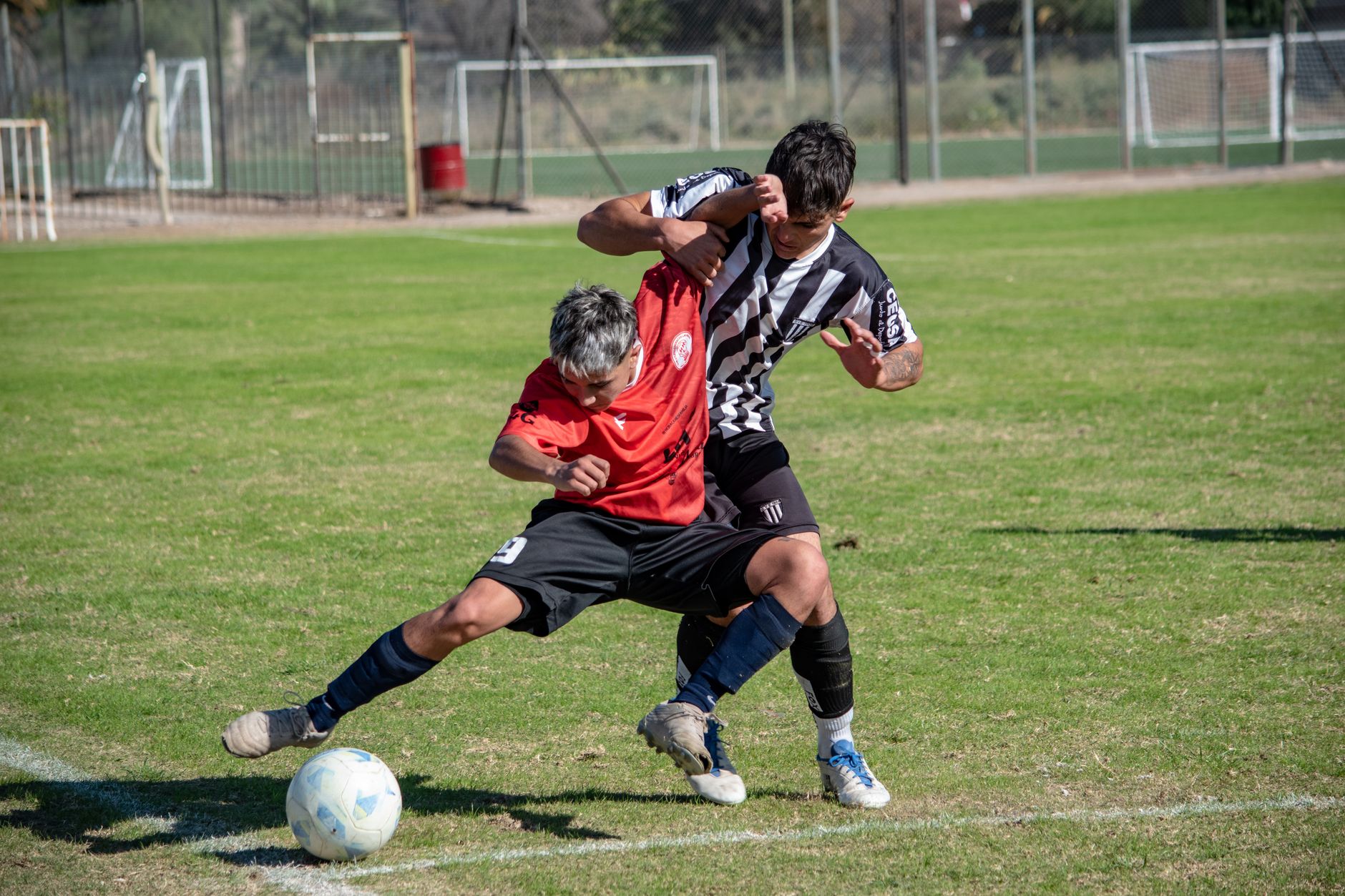
Photo by Franco Monsalvo on Pexels
Another weakness was excessive training volume. Daily maximal 1v1 sessions created sore calves, slower reactions, and increasingly careless touches. Technical learning requires repetition, but fatigue changes the movement pattern being repeated. Schedule two high-intensity dribbling sessions and two lighter technical sessions each week, leaving at least 24 hours between demanding lower-body workloads. A simple four-week progression works well:
- Week one: predictable touches, both feet, 60 to 75 percent speed.
- Week two: random gates, scanning cues, and controlled acceleration.
- Week three: passive defenders progressing to active pressure.
- Week four: small-sided games with scoring rewards for successful carries and smart releases.
Track the same four indicators each week: lost balls, weak-foot touches, successful exits, and decision delay. Do not change every variable at once. If you add a new ball, new surface, new drill, and new workload simultaneously, you will not know what caused improvement or failure. Rigour is less exciting than guesswork, but it wins.
Would I Use It Again?
Yes, but only as a progression rather than a fixed routine. Ten minutes of focused ball mastery can improve touch frequency and confidence, yet match-ready dribbling requires perception, pressure, acceleration, and a decision after the action. My preferred weekly structure is 10 minutes of technical control, 10 minutes of reactive movement, 15 minutes of opposed practice, and 20 minutes of small-sided play. The final block is essential because it tests whether the player knows when not to dribble. A successful footballer does not maximise carries; the player maximises useful outcomes such as advancing possession, creating numerical superiority, drawing a defender, or opening a passing lane. World Cup Hub readers comparing teams at the 2026 FIFA World Cup should therefore examine progressive carries alongside turnovers, carries into the penalty area, completed take-ons, and the location of each action.
The clearest recommendation is to use a traffic-light scoring system after every session. Green means at least 80 percent clean technical repetitions and two or more successful pressured exits; amber means accuracy between 60 and 79 percent or repeated posture breakdown; red means accuracy below 60 percent, pain, or uncontrolled fatigue. Progress only one difficulty level when the player stays green for two sessions. This prevents the classic mistake of adding a defender because the cones looked easy, even though the player was already losing the ball during the final repetitions. “Practice does not make perfect; practice makes permanent” is a useful coaching principle, but only when the permanent pattern is technically sound. Want to apply these ideas while following elite tournament tactics?
[Internal Link: 30-day football skills training plan]
Frequently Asked Questions
Q: What does football dribbling mean?
A: Football dribbling means moving with the ball while maintaining control and creating an advantage over space or an opponent. Effective dribbling combines close touches, body feints, changes of speed, scanning, and a decision to pass, shoot, shield, or continue. A player may dribble past an opponent, carry the ball into space, or use a short escape touch to avoid pressure. The action is successful when it improves the team’s position, not merely when it looks technically impressive.
Q: How can I improve football dribbling skills at home?
A: You can improve at home by using a small safe area, a properly inflated ball, and 10 to 20 minutes of structured practice. Begin with inside-outside touches, sole rolls, figure-eight movements, and weak-foot repetitions, then add visual cues such as numbered gates or coloured targets. Keep the ball within 0.5 to 1 metre during control work and record misplaced touches rather than guessing whether the session was effective. Avoid practising at full speed on a slippery or crowded surface.
Q: What is the difference between cone dribbling and 1v1 dribbling?
A: Cone dribbling develops predictable ball control and coordination, while 1v1 dribbling develops perception, deception, timing, and decision-making against an opponent. Cones help players rehearse foot contacts and body angles, but they do not react or change pressure. Use cone work for approximately 40 to 50 percent of a session, then progress to passive defenders, active defenders, and small-sided games. Both methods are valuable, but neither replaces the other.
Q: Why does my football dribbling fail during matches?
A: Match dribbling often fails because players scan too late, use excessive touches, accelerate without space, or practise only predictable patterns. Check whether your first touch moves toward pressure, whether your body protects the ball, and whether you identify the next action before receiving. A useful correction is to add random visual cues and a defender after the first touch, then measure successful exits and ball losses. Fatigue and poor spacing can also expose technical weaknesses that do not appear in relaxed drills.
Q: How often should I practise dribbling skills?
A: Most players can practise dribbling three to four times weekly, with two demanding sessions and one or two lighter technical sessions. High-intensity 1v1 work should be separated by at least 24 hours when possible, especially for young players or athletes also completing sprint training. A typical session may include 10 minutes of ball mastery, 10 minutes of reactive work, 15 minutes of opposed practice, and 20 minutes of small-sided play. Reduce volume when technique deteriorates or pain appears.
Q: Do I need expensive equipment to improve football dribbling?
A: You do not need expensive equipment; a football, six cones or household markers, a stopwatch, and a safe training space are enough to begin. A size-5 ball is standard for most adult players, while younger age groups may benefit from a size-4 ball. You can replace cones with flat markers, but avoid objects that create a tripping hazard. Equipment improves organisation, not talent, so measure touches, decisions, and successful exits instead of purchasing every product advertised online.
Q: Should I learn advanced football tricks to become a better dribbler?
A: Advanced tricks are optional and should follow reliable control, scanning, and 1v1 decision-making. Start with body feints, shoulder drops, stop-start acceleration, and inside-outside touches because these actions transfer more consistently to competitive matches. Add a complex move only when you can execute it with both feet, at speed, and under moderate pressure. If the trick does not create space, protect possession, or eliminate a defender, it is probably performance rather than effective dribbling.
Build the habit, measure the outcome, and test every technique against real pressure. That is how football dribbling skills improve—not through miracle promises, fake shortcuts, or a ten-second compilation of someone else’s feet. World Cup Hub can help you connect individual technique with the tactical patterns shaping the 2026 FIFA World Cup, so take the next step with evidence rather than hype.
Ready to follow more football tactics, player statistics, and tournament analysis?